
Identify What's Slowing You Down. Remove it. Fast.
We identify hidden losses and eliminate key operational weakness in 30 days.
With financial guarantee.
3-day diagnostic
30-day execution
Capacity & EBITDA focus
On-site execution
EFFICIENCY EXPERTS
Why Performance Stalls.
According to US NAM, Rockwell and Deloitte 2024-2025 top 600 US manufacturer studies:
THE PROBLEM


Blurred Priorities
Too many initiatives.
Competing KPIs.
Stalled Improvements.
Recurring Escalations.
Misleading Data
Clean/green dashboards.
Reports dail to explain disruptions, losses, delays or firefighting.

Bottlenecks Hide in the Routine
Slow Change & Internal Resistance
WIP piles up and fluctuates. Many mirco-stops, starvations, walking around, searching, rework.
Reasoning why not to do it. Improvements stalled at 80%. Energy exists verbally, not behaviorally.

Lack confidence their strategy will deliver results.
Lack confidence in data collection.
Say undocumented workarounds hide losses.
Find resistance to change as a key improvement obstacle.
49%
75%
72%
56%
Focused Process. Measureable Results.
HOW WE WORK

20-min
Pain & Symptom Call
60-min
On-Site Visit
3-day
Operational Diagnostic
30-day
Weakness Elimination
You explain the operational pain.
We turn the symptoms into a focused on-site check.
We verify whether the symptoms in your operation point to hidden loss large enough for a full diagnostic. You decide on 3-day diagnostic
We measure where performance is leaking money, quantify the EBITDA impact, and isolate the weakness with the strongest €100k+ OPEX recovery potential.
We lead focused execution, control implementation risks, and help your team capture the €100k+ annual cost-saving opportunity identified in the diagnostic.


1
2
3
4
FREE OF CHARGE
FREE OF CHARGE
Two Services. One Goal - Unlock Performance.
Operational Diagnostics
A concentrated on-site operational assessment to find your biggest weakness and quantify the opportunity.
OUR SERVICES




Weakness Elimination
3
DAYS
30
DAYS
A focused 30-day execution sprint to remove your biggest constraint and deliver tangible results.
Process mapping & timing
Constraint identification & validation
EBITDA impact quantification
Prioritized action roadmap
Rapid implementation
Daily management & accountability
Risk & resistance management
Financial guarantee

Tangible Results from Real-Life Operations.
PROOF

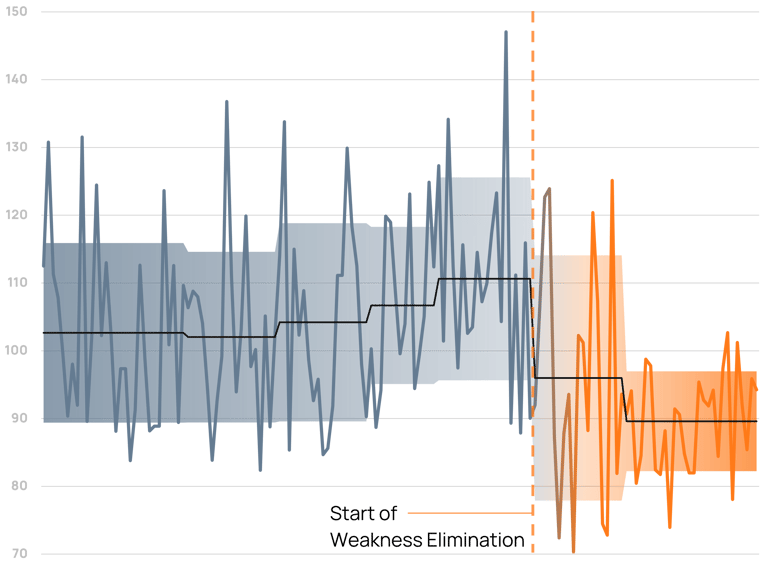
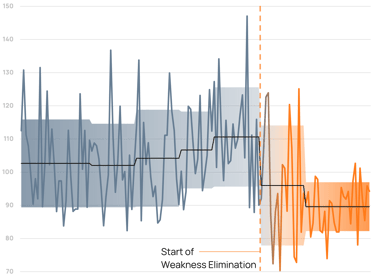
Decrease in Direct Labor Minutes per Unit:
+12%
Output Increase
-20%
Leadtime Decrease
-150k Eur
Direct Labor Costs
LOW PROFIT MARGIN MANUFACTURING CLIENT
Unlocked capacity. Reduced lead time. Stabilized execution.
A high-mix, manual make-to-order operation was constrained with fluctuating output, long lead times, and uneven flow. We identified the true bottleneck and executed an elimination plan.
Focused on Fast & Tangible Improvement.
ABOUT
Stronger Operations exists to help manufacturing leaders identify the operational weakness with the highest EBITDA impact, prove it with data, and eliminate it through focused execution.
We do not sell software. We do not run abstract Lean workshops.
We go inside the operation, expose the real weakness, and turn it into measurable improvement.




Operational & Strategic Mindset
We've run operations. We speak your language. We connect shop-floor reality with business performance.
Hands-On Approach
On-Site. In the details. Working with operators, shift leaders, and managers where the weakness actually lives.
EBITDA-Focused Improvement
We connect operational fixes to financial impact, not cosmetic activity.
Clear Operational Truth
We separate opinions, symptoms, and assumptions from measurable facts.
I’ve spent 10+ years improving manufacturing operations across very different environments — from manual make-to-order production to automated, high-speed manufacturing and engineer-to-order systems.
I’ve seen the same pattern repeat: companies often do not lack effort, people, or ideas. They lack clear proof of where performance is leaking money — and controlled execution to remove the weakness without creating more chaos.
Hi, I’m Lukas Nasteckis, founder of Stronger Operations.